
Primavera P6 for Core Industries in India are closely connected with large and complex projects. Construction, infrastructure, engineering, EPC, power, utilities, oil and gas, manufacturing, industrial plants, and other project-driven sectors require careful planning, scheduling, resource coordination, progress monitoring, and project control.
In such environments, project teams cannot depend only on spreadsheets or informal activity lists. They need structured schedules that show what has to be done, when it has to be done, what depends on what, which activities are critical, and how actual progress compares with the plan.
This is where Primavera P6 for Core Industries become an important project-planning skill.
Click Here to Enroll… Primavera P6
Oracle describes a solution to use Primavera P6 for Core Industries for planning, managing, and executing projects and portfolios, with capabilities including CPM scheduling, resource management, cost and schedule management, progress tracking, and change management.
At Kamruhan, we help students, engineering graduates, planning professionals, and working professionals understand Primavera P6 through a practical project-oriented approach, with particular relevance to the requirements of India’s core and project-based industries.
To know More → Refer Kamruhan Blogs
What Are Core Industries?
Core industries generally refer to sectors that form an important foundation for economic and industrial activity. In India, project-based work can be found across areas such as:
- Construction and infrastructure
- Engineering and EPC
- Power and utilities
- Oil and gas
- Manufacturing
- Industrial plants
- Transportation and infrastructure development
- Heavy engineering
- Government and public-sector projects
- Large-scale commercial and industrial developments
The exact project structure differs from one industry to another, but many projects share common requirements:
Planning → Scheduling → Resource Management → Execution → Monitoring → Control → Completion
Primavera P6 for Core Industries can support this structured approach to project planning and scheduling.
Oracle’s P6 documentation also provides industry-specific settings for areas including Engineering and Construction, Utilities/Oil and Gas, Government/Aerospace/Defense, and High Technology/Manufacturing, showing that the software can be configured with different terminology and default calculation settings for different project environments.
Why Primavera P6 for Core Industries in India matters ?
Large projects often involve thousands of activities and multiple teams working simultaneously.
Consider an industrial construction project.
The overall project might include:
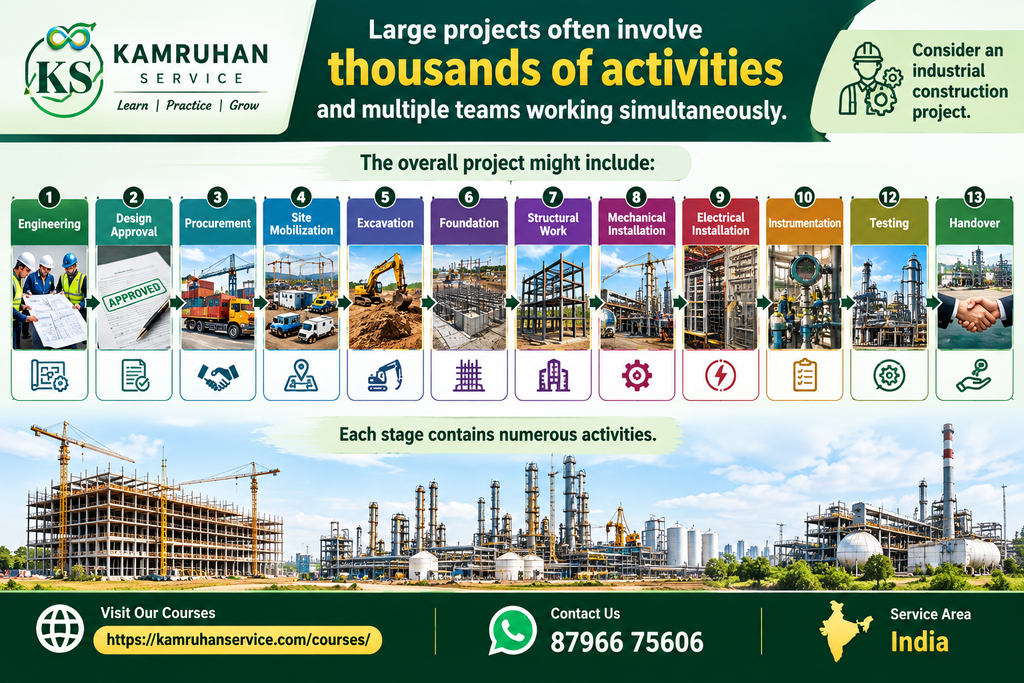
Each stage contains numerous activities.
A delay in procurement can affect installation. A delay in foundation work can affect structural activities. Delayed equipment delivery can affect commissioning.
Therefore, project planning requires an understanding of activity relationships, dependencies, durations, resources, milestones, critical paths, and progress.
Primavera P6 for Core Industries provides tools for building and analyzing this type of schedule. Oracle’s current P6 Professional documentation includes WBS, CPM scheduling, resource leveling, reporting, and project-control functionality.
1. Primavera P6 for Core Industries in Construction and Infrastructure
Construction is one of the clearest examples of a project environment where planning and scheduling are important.
A construction project can contain activities such as:
- Site mobilization
- Surveying
- Excavation
- Foundation
- Reinforcement
- Formwork
- Concrete
- Structural work
- MEP installation
- Finishing
- Testing
- Commissioning
- Handover
These activities need to be logically organized.
For example:
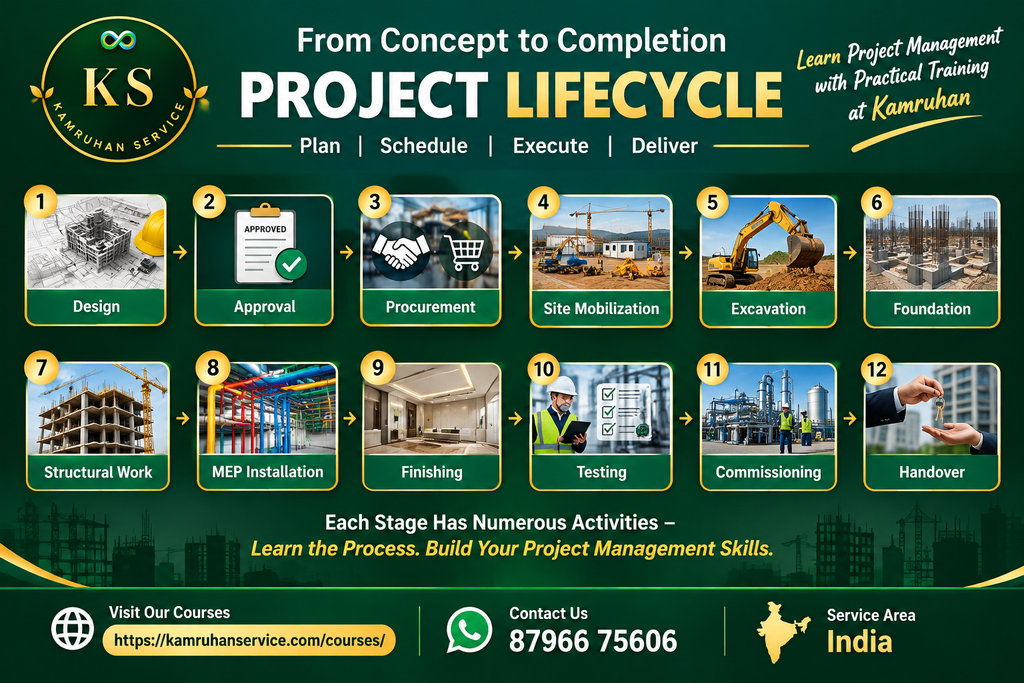
Primavera P6 for Core Industries _ An illustration to understand better
↓
Planner _ Primavera P6 Environment
A planner can use Primavera P6 to represent the project structure, establish activity relationships, schedule the work, and monitor changes to the plan.
This makes Primavera P6 particularly relevant for professionals involved in construction planning, scheduling, and project controls.
2. Primavera P6 for Core Industries in EPC Projects
Engineering, Procurement and Construction (EPC) projects can involve several departments and organizations working together.
A typical EPC project may include:
Engineering
- Design development
- Engineering documents
- Drawings
- Technical approvals
Procurement
- Material requisitions
- Vendor selection
- Purchase orders
- Manufacturing
- Inspection
- Delivery
Construction
- Mobilization
- Civil works
- Structural works
- Equipment installation
- Piping
- Electrical
- Instrumentation
Commissioning
- Pre-commissioning
- Testing
- Commissioning
- Performance verification
- Handover
The challenge is that these functions are interconnected.
For example, construction cannot install equipment until the equipment is delivered. Procurement cannot always proceed without approved technical specifications. Engineering changes can affect procurement and construction.
A project schedule can help visualize these relationships.
3. Primavera P6 for Core Industries in Oil and Gas
Oil and gas projects often involve engineering, procurement, fabrication, logistics, construction, installation, testing, and commissioning.
Examples of project activities can include:
Engineering
↓
Equipment Procurement
↓
Fabrication
↓
Material Delivery
↓
Site Installation
↓
Piping
↓
Mechanical Completion
↓
Pre-Commissioning
↓
Commissioning
The project planner needs to understand how these activities interact.
Oracle specifically provides an Utilities, Oil, and Gas industry setting within Primavera P6 Professional, with terminology and default calculation settings aligned to that industry type.
For professionals targeting project planning roles in industrial and energy-related environments, understanding Primavera P6 alongside project scheduling fundamentals can therefore be useful.
4. Primavera P6 for Core Industries in Power and Utilities
Power and utility projects can involve large quantities of engineering, procurement, construction, installation, testing, and commissioning work.
For example, a power project may involve:
- Site development
- Civil works
- Foundations
- Structural work
- Equipment procurement
- Equipment installation
- Electrical works
- Cabling
- Testing
- Commissioning
The project schedule can help the team understand the planned sequence and monitor progress.
Oracle includes Utilities, Oil, and Gas as a dedicated industry type in P6 Professional’s configuration options.
5. Primavera P6 for Core Industries in Manufacturing Projects
Manufacturing projects may include plant construction, machinery installation, production-line setup, equipment testing, and commissioning.
For example:
Plant Design
↓
Equipment Procurement
↓
Equipment Delivery
↓
Foundation Preparation
↓
Equipment Installation
↓
Electrical & Instrumentation
↓
Testing
↓
Trial Run
↓
Production Start
The planner must consider the relationship between equipment availability, installation activities, testing, and commissioning.
Oracle also provides a High-Technology, Manufacturing and Others industry configuration within P6 Professional.
6. Primavera P6 for Core Industries _ Project Planning Engineers
A Planning Engineer may be responsible for much more than creating a Gantt chart.
Typical planning responsibilities can involve:
- Developing the project schedule
- Creating WBS
- Creating activities
- Assigning durations
- Establishing relationships
- Developing the baseline
- Updating progress
- Monitoring critical activities
- Analyzing delays
- Preparing reports
- Coordinating with engineering, procurement and construction teams
Primavera P6 for Core Industries provides functionality specifically aimed at project planners and schedulers, including WBS, CPM scheduling, resource leveling, reporting, and project tracking.
This is why a good Primavera P6 for Core Industries learning program should teach project planning concepts alongside the software.
7. Understanding WBS using Primavera P6 for Core Industries Projects
The Work Breakdown Structure (WBS) is one of the most important concepts for building a project schedule.
Imagine an industrial project:
Industrial Plant Project
→ Engineering
→ Procurement
→ Civil Works
→ Structural Works
→ Mechanical Works
→ Electrical Works
→ Instrumentation
→ Testing
→ Commissioning
→ Handover
Each section can then be divided into smaller work packages and activities.
A well-organized WBS helps project teams view the project at different levels.
It also provides a foundation for organizing activities, progress, resources, and reporting.
8. Critical Path and Schedule Control
One of the most important Primavera P6 for Core Industries concepts is Critical Path Method (CPM).
The schedule uses activity durations and relationships to calculate project dates and schedule paths. Oracle’s documentation identifies CPM scheduling as a core P6 capability.
A planner should understand:
- Critical activities
- Total Float
- Free Float
- Activity relationships
- Longest path
- Early dates
- Late dates
- Project completion date
This leads to an important project-planning question:
If this activity is delayed, what happens to the rest of the project?
That question is more important than simply knowing how to enter a duration into software.
9. Procurement and Primavera P6 for Core Industries
Procurement is often a major component of core-industry projects.
Imagine that a major piece of equipment is required before installation can begin.
The schedule could include:
Technical Specification
↓
Material Requisition
↓
Tender / Vendor Selection
↓
Purchase Order
↓
Manufacturing
↓
Inspection
↓
Dispatch
↓
Delivery
↓
Installation
↓
Testing
If procurement is delayed, subsequent activities may also be affected.
This is why planners need to understand engineering-procurement-construction relationships rather than looking at construction activities in isolation.
10. Progress Monitoring with Primavera P6 for Core Industries
A project schedule is not useful only at the beginning of a project.
It must be updated as the project progresses.
A typical update process may involve:
- Establishing the data date.
- Recording actual starts.
- Recording actual finishes.
- Updating remaining durations.
- Entering progress.
- Reviewing relationships.
- Rescheduling.
- Comparing with the baseline.
- Reviewing critical activities.
- Preparing reports.
Oracle’s current P6 Professional documentation describes setting the project data date and using the Schedule function to calculate the project schedule.
This makes schedule updating an important practical skill for planning professionals.
11. What Happens When a Project Is Delayed?
Consider a simple example.
Suppose equipment installation was planned to begin on 1 August, but the equipment arrives on 15 August.
A planner should not simply change one date and finish the update.
The planner should investigate:
- What caused the delay?
- Which activities depend on equipment installation?
- Does the delay affect commissioning?
- Has available float changed?
- Has the critical path changed?
- Is the project completion date affected?
- Are recovery actions possible?
These are project-control questions.
Primavera P6 for Core Industries provides scheduling and analysis capabilities that can help planners examine these relationships and schedule impacts.
12. Primavera P6 for Core Industries used in Project Management
Project management – Primavera P6 for Core Industries should not be treated as two completely separate subjects.
Project management provides the overall framework.
Primavera P6 provides a structured environment for planning and scheduling project activities.
The connection can be viewed as:
Project Scope
↓
WBS
↓
Activities
↓
Relationships
↓
Schedule
↓
Resources
↓
Baseline
↓
Execution
↓
Progress Update
↓
Schedule Analysis
↓
Project Control
This is why professionals learning Primavera P6 should also understand basic project management principles.
#https://docs.oracle.com/cd/F37128_01/English/User_Guides/p6_pro_user/
Practical Primavera P6 for Core Industries Training at Kamruhan
At Kamruhan, the focus is on helping students and professionals understand how Primavera P6 for Core Industries works in practical project environments.
Learning should go beyond simply memorizing software commands.
For example, a learner should be able to answer:
Why is this activity connected to another activity?
Because the sequence may represent a project dependency.
Why is this activity critical?
Because its position in the schedule can influence the calculated project completion date.
Why did the project completion date change?
Because changes in durations, relationships, constraints, progress, or other schedule conditions may alter the calculated schedule.
Why did float reduce?
Because changes in the schedule network or activity dates can affect available schedule flexibility.
What happens if procurement is delayed?
The planner should examine which downstream activities depend on the procurement item and whether the delay affects the project completion date.
Which activities require management attention?
The project team can examine critical activities, near-critical activities, delayed activities, milestones, and other schedule indicators.
How should progress be measured?
Progress should be connected to the project’s approved plan, actual execution, activities, milestones, and appropriate measurement methods.
These are project-planning questions, not simply software questions.
That distinction is important.
Career Path with Primavera P6 in Core Industries
Primavera P6 can complement a professional’s existing engineering, construction, procurement, or project-management background.
A possible career progression is:
Engineering Graduate / Engineer
↓
Primavera P6 Training
↓
Planning Engineer / Project Planner
↓
Planning & Scheduling Engineer
↓
Project Controls Engineer
↓
Senior Planning Engineer
↓
Project Controls Lead / Manager
↓
Project Manager
↓
Senior Project Manager
The exact progression varies according to industry, organization, qualifications, experience, and job responsibilities.
For someone beginning a career, Primavera P6 can be learned alongside project planning fundamentals. For an experienced professional, it can complement existing technical or project-management experience.
Who Should Learn Primavera P6 for Core Industries?
This training can be relevant to:
Civil Engineers
For construction and infrastructure planning.
Mechanical Engineers
For industrial, EPC, plant, equipment, and mechanical projects.
Electrical Engineers
For electrical installation, infrastructure, power, and commissioning projects.
Planning Engineers
For schedule development, updates, analysis, and reporting.
Project Controls Professionals
For schedule and broader project-control activities.
Project Engineers
For understanding project execution from a planning perspective.
Project Managers
For better understanding schedule logic, milestones, progress, and project performance.
Engineering Graduates
For building foundational knowledge in project planning and scheduling.
Why Learn Primavera P6 with Practical Project Examples?
A software course can teach you where to click.
A project-oriented course should help you understand why you are clicking it.
For example:
Software Skill:
Create an activity.
Practical Skill:
Understand what the activity represents in the project’s scope.
Software Skill:
Create a relationship.
Practical Skill:
Understand the dependency between two activities.
Software Skill:
Run the schedule.
Practical Skill:
Understand how the schedule dates and float change.
Software Skill:
Update progress.
Practical Skill:
Understand the project’s current position against its plan.
This is the type of connection that Kamruhan aims to build through practical Primavera P6 learning.
Conclusion: Build Powerful Project Planning Skills with Primavera P6
India’s core and project-based industries require professionals who can understand not only technical work but also how projects are planned, scheduled, monitored, and controlled.
From construction and infrastructure to EPC, power, utilities, oil and gas, and manufacturing, projects can involve complex sequences of engineering, procurement, construction, installation, testing, and commissioning.
Primavera P6 provides a structured platform for project planning and scheduling, with capabilities including WBS, CPM scheduling, resource management, progress tracking, reporting, and schedule control.
But the software itself is only one part of the learning journey.
The stronger foundation comes from understanding:
Project Management + Planning + Scheduling + CPM + Resources + Progress + Analysis + Project Controls
At Kamruhan, we help students and professionals connect these concepts with practical Primavera P6 learning and project-oriented examples.
Whether your interest is construction, infrastructure, EPC, power, oil and gas, manufacturing, or another project-based industry, developing structured planning and scheduling skills can complement your existing technical and professional knowledge.
Learn → Practice → Analyze → Apply → Grow #
Learn Primavera P6 for Core Industries with Kamruhan and build practical project-planning skills for India’s core industries.
📱 WhatsApp: 87966 75606
🌐 Courses: Kamruhan Service Courses
🇮🇳 Service Area: India