Mastering Project Planning with Primavera P6
Primavera P6 Training is a fun to learn with Kamruhan . Its more than a scheduling tool for Planning Engineers, Project Managers, and Project Controls professionals providing a structured, data-driven approach to planning, scheduling, monitoring, and controlling complex projects.
#
https://kamruhanservice.com/courses/oracle-primavera-p6-basic-course/
Whether you are working on construction, infrastructure, EPC, engineering, manufacturing, oil & gas, or other large-scale projects, understanding Primavera P6 can help you develop practical project planning and scheduling skills.
At Kamruhan Service, our approach focuses on Primavera P6 Training concepts connecting with practical project execution, helping learners understand how professional Planning Engineers use scheduling principles in real-world projects.
#
https://www.oracle.com/in/construction-engineering/primavera-p6/
6 Essential Primavera P6 Training Concepts- Every Planning Engineer Learns with us
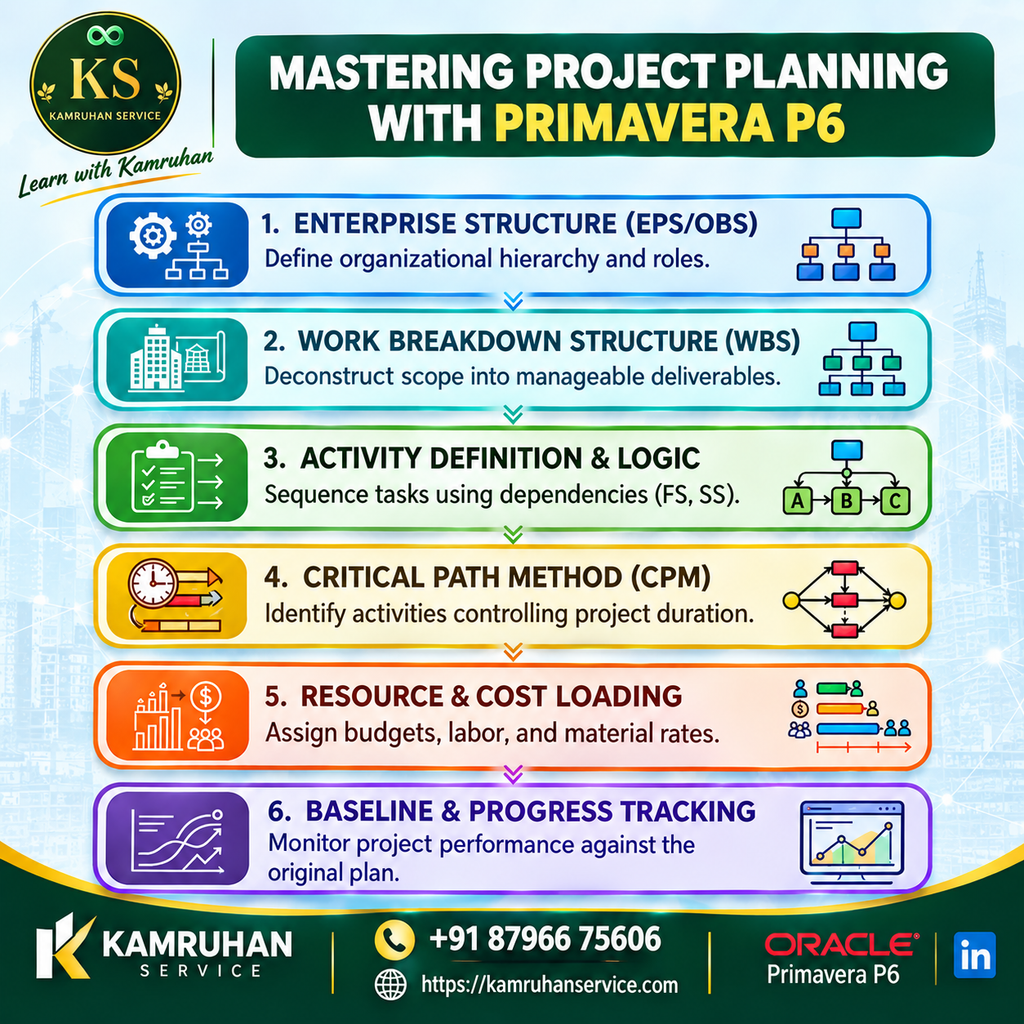
1. Enterprise Structure (EPS/OBS)
Before creating a project schedule, it is important to understand the organizational structure.
Enterprise Project Structure (EPS) helps organize projects within an enterprise, while the Organizational Breakdown Structure (OBS) represents the responsible management structure.
Learning EPS and OBS helps Planning Engineers understand:
- Project hierarchy
- Organizational responsibilities
- Project ownership
- Management structure
- Responsibility assignment
2. Work Breakdown Structure (WBS)
A Work Breakdown Structure (WBS) divides a large project scope into smaller and manageable components.
A properly structured WBS helps Planning Engineers organize project activities and maintain better control over project deliverables.
In Primavera P6, WBS can be used to structure projects according to:
- Project phases
- Engineering activities
- Procurement
- Construction
- Testing and commissioning
- Individual deliverables
3. Activity Definition & Logic
Activities represent the actual work that needs to be completed.
Planning Engineers need to define activities and establish logical relationships between them. Common Primavera P6 relationships include:
- Finish-to-Start (FS)
- Start-to-Start (SS)
- Finish-to-Finish (FF)
- Start-to-Finish (SF)
Proper activity logic allows the schedule to respond appropriately when project dates, durations, or dependencies change.
4. Critical Path Method (CPM)
The Critical Path Method (CPM) is one of the most important concepts in project scheduling.
CPM helps identify the sequence of activities that controls the overall project duration. Understanding critical activities and float enables Planning Engineers to monitor schedule performance and identify potential schedule risks.
With Primavera P6, professionals can analyze:
- Critical activities
- Total float
- Activity relationships
- Project duration
- Schedule changes
- Potential delays
5. Resource & Cost Loading
Professional project planning goes beyond activity dates.
Resource and cost loading in Primavera P6 helps organizations understand how manpower, equipment, materials, and costs are distributed throughout a project.
Planning Engineers can use resource and cost information for:
- Resource allocation
- Manpower planning
- Budget monitoring
- Cost forecasting
- Resource optimization
- Project performance analysis
6. Baseline & Progress Tracking
A baseline provides a reference against which actual project performance can be measured.
Once a baseline is established, Planning Engineers can compare planned and actual performance and identify schedule variances.
Primavera P6 Training at Kamruhan can help individuals learn how to support project monitoring through:
- Baseline comparison
- Progress updating
- Schedule variance analysis
- Look-ahead planning
- S-Curve analysis
- Project performance reporting
Why Primavera P6 Training with Kamruhan?
Learning effectively requires more than understanding software buttons and menus. A strong Primavera P6 Training approach combines project planning concepts, scheduling techniques, practical exercises, and real-world project scenarios.
At Kamruhan Service, the focus is on helping learners develop practical skills in:
- Primavera P6 project planning
- Project scheduling
- WBS development
- Activity sequencing
- CPM and critical path analysis
- Resource and cost loading
- Baseline management
- Progress monitoring
- Project controls
- Planning and scheduling reports
Build Your Career post Primavera P6 Training at Kamruhan
For Civil Engineers, Mechanical Engineers, Planning Engineers, Project Engineers, and construction professionals, Primavera P6 can become an important part of a broader project-management career path.
A typical progression can include:
Engineer → Primavera P6 Learner → Planning Engineer → Project Planner / Scheduler → Senior Planning Engineer → Project Controls Engineer → Planning Manager → Project Manager
The skills you develop should complement your existing engineering and project-management knowledge.
Primavera P6 Training Online with Kamruhan
Kamruhan provides online Primavera P6 training and project planning solutions, making the learning approach accessible to professionals and learners across India at their own comfort.
Whether your goal is to strengthen your current planning skills, understand Primavera P6 from the fundamentals, or develop practical project scheduling knowledge, you can build your learning journey step by step.
Learn. Practice. Plan. Grow.
Start building your Primavera P6 and project planning skills with Kamruhan.
Website: kamruhanservice.com